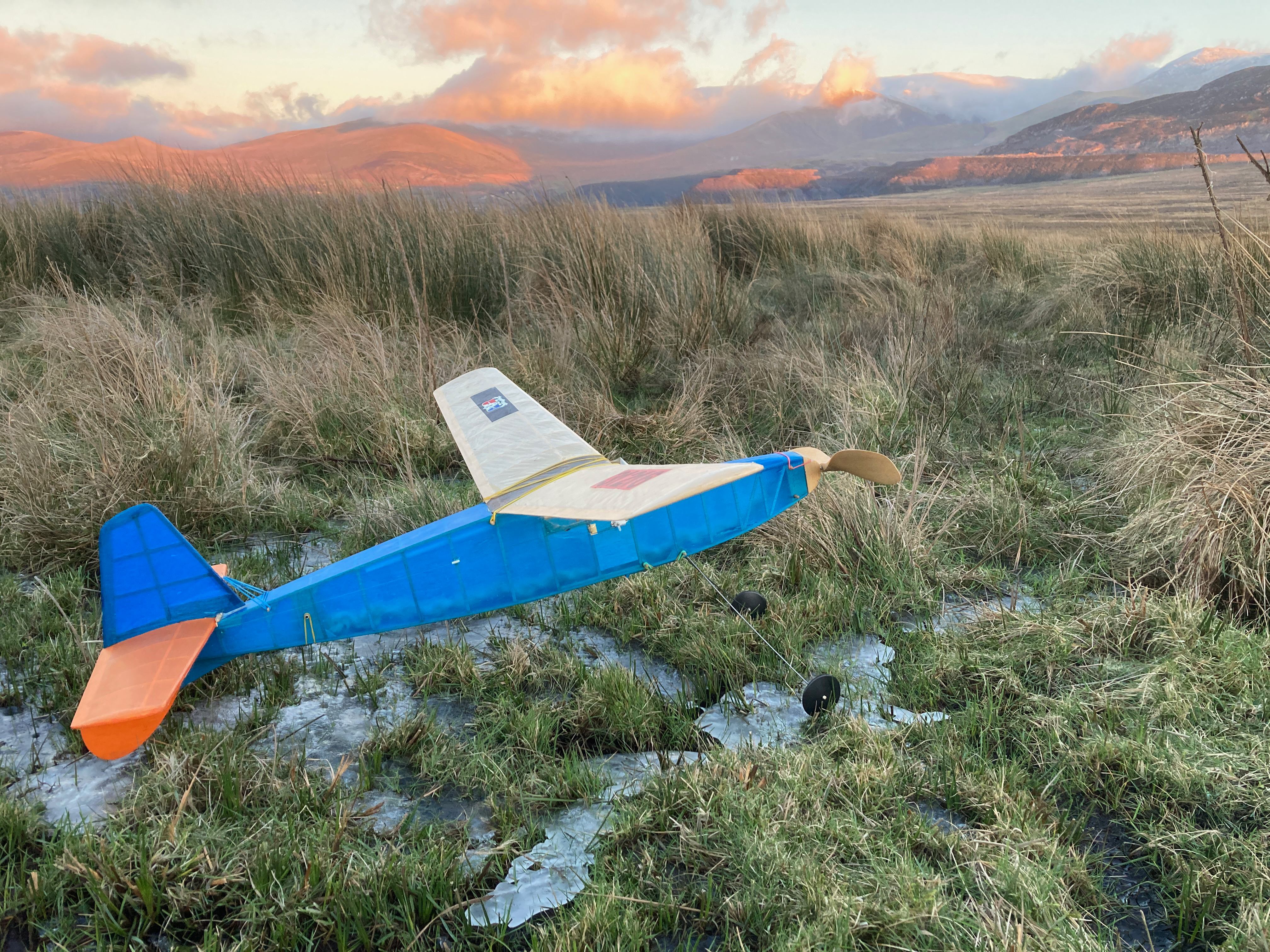
Fulfilling CAA guidelines
CAA guidelines and rules for Free Flight models in the UK
Personally I was confused by the CAA/BMFA rules as they apply to free flight models. I hope the following make things clear: In summary :
Do not fly near airports!
If you only fly models under 100g, without a camera, you need no CAA operator/Flyer registration.
For models over 250g (or those >100g, carrying a camera), you will need to take the BMFA registration test to get a CAA
operator number and this needs to be on your plane.
There are guidelines taken from the BMFA site, set out below.
Full details: https://rcc.bmfa.club/
ClickHere to take the BMFA Registration Competency Certificate test
The most relevant parts of the law are reproduced below:
2.
Free Flight Model Aircraft
Our Authorisation defines a free flight model
aircraft as follows:
A free flight model aircraft cannot be remotely piloted and does
not have software or systems for autonomous control of the
flight path. A flight termination device may be fitted. The
aircraft trim is adjusted prior to flight. The aircraft is
trimmed (and fuelled if applicable) with the intent that it
will follow a substantially circular path relative to the
air and ultimately glide to a low velocity landing. A
free-flight unmanned aircraft will drift relative to the
user depending upon the speed and direction of the wind. The
person in charge of the free-flight unmanned aircraft is
deemed to be the remote pilot for the purposes of this
authorisation.
Some specific requirements for free flight have been included
within our Authorisation. Most of these requirements are not
new and generally reflect the requirements of the existing law
(and how it should have been being applied already):
Prior to launching their aircraft, the remote pilot should take
into account the expected performance of the aircraft, the
weather conditions and the availability of any flight
termination device and must be reasonably satisfied that the
expected flight path will not infringe an FRZ (unless prior
permission has been obtained) or other airspace restriction.
The operation of a free flight model aircraft must only be
carried out within the limits of our Authorisation (or
alternatively within the requirements of the Open Category,
especially for those aircraft with an MTOM of less than 250g).
A free flight model should not be deliberately flown beyond visual line of sight.
A free flight model aircraft must only be launched:
From an area free from uninvolved persons (Uninvolved
persons are those who are not participating in the UAS
operation or who are not aware of the instructions and
safety precautions given by the UAS operator).
When the remote pilot has identified an area (the ‘flight
volume’) within which they believe the aircraft will remain.
When the remote pilot is reasonably satisfied that the aircraft
will remain within the flight volume.
When the remote pilot is reasonably satisfied at the point of
launch that no uninvolved persons will enter the flight
volume and be endangered.
Within the terms of out Authorisation, the Operator/Remote Pilot of
any free flight aircraft with an MTOM of less than 250g which
is likely to operate at a height above 400ft, must be
registered as an Operator and have evidence of Competency
(such as passing the BMFA online test).
4.1
Operator Registration
The existing requirements for Operator registration remain in place.
It is a legal requirement that anyone operating an unmanned
aircraft outdoors be registered as an Operator with the CAA
unless:
the aircraft weighs 250g or less and is not fitted with a camera; or
the aircraft is a control line or round-the-pole (tethered) aircraft
that weighs less than 7.5Kg and operates on tethers of less than 25m;
The Operator I.D. number must be clearly displayed on the aircraft or
within a compartment that can be easily accessed without the use of a tool.
4.2
Operator Responsibilities
Our Authorisation includes a requirement for Operators to comply with
the following requirements (largely common sense):
Ensure the remote pilot is in possession of the relevant remote pilot competence requirements and has a valid CAA Flyer ID.
Ensure that the model aircraft is sufficiently maintained, and that any repairs carried out to it are satisfactorily made, such that it is in a safe condition to be flown;
Ensure that the remote pilot is aware of the limitations and conditions of this authorisation;
Ensure that the remote pilot is aware of the rules and procedures of their relevant association;
Ensure that any necessary additional permissions or authorisations are obtained for any specific flight;
Ensure the remote pilot is aware of any relevant airspace limitations;
The CAA acknowledges that in many instances, the operator and the
remote pilot will be the same person. In such cases, this person
must discharge the responsibilities of both the remote pilot (see
Section 6), and the Unmanned Aerial System (UAS) Operator.
5.1
Remote Pilot Competence
It is a legal requirement that anyone who flies a model aircraft or
drone outdoors with a take off mass 250gm or above must have a
CAA Flyer ID. Previously BMFA members who hold a valid BMFA
Registration Competency Certificate (RCC), or a BMFA A or B
Certificate passed before 31/12/2020, did not require a CAA
Flyer ID. This has now changed and you will require a CAA
Flyer ID. However the BMFA can request the Flyer ID on your behalf.
There are two acceptable methods for BMFA members to show evidence of Remote Pilot Competence and to obtain a Flyer ID.
Have a valid BMFA Registration Competency Certificate (RCC)**,
or
Passingthe CAA online DMARES test.
The
BMFA strongly recommend all members take and pass the updated
Registration Competency Certificate as it is most relevant to how
our members operate and is an excellent way of ensuring
understanding of our Authorisation. When
you upload a valid Registration Competency Certificate to the
BMFA Membership portal at https://bmfa.justgo.com we
will then request a Flyer ID for you from the CAA.
7. How
high can I fly?
The new regulations limit the operation of all unmanned
aircraft to 400ft above the surface. However, our Authorisation
permits members to fly above 400ft, subject to:
The model aircraft is not a rotorcraft (multi-rotor) with more than two lift generating rotors or propellers.
The model aircraft is not automated. (This means a model aircraft with autonomous or automatic flight capability. This does not include systems which are fitted for flight stabilisation purposes or flight termination purposes, such as free-flight termination devices).
The model aircraft in not operating with the Flight Restriction Zone of an aerodrome, other than with the written permission/agreement with the aerodrome.
The model aircraft remains within visual line of sight of the remote pilot.
The model aircraft has a MTOM of not more than 7.5Kg.
Any slope soaring model glider with a MTOM exceeding 7.5kg but not more than 14kg may be flown up to 400ft above the remote pilot, even though it may then be flying more than 400ft above the surface directly beneath the glider.
10.
Provisions for ‘trial flights’
Our Authorisation permits the continuance of ‘trial
flights’ for non-members.
The non-member may operate the controls of the model aircraft and does not need to comply with the competency requirements whilst under the direct supervision of a member.
The member supervising the flight must be registered as an Operator and display their Operator I.D. on the aircraft.
11.
Provisions for Overseas Visitors/Competitors
Overseas visitors/competitors are permitted to operate
within the terms of our Authorisation provided that they hold a
temporary membership of the BMFA and agree to comply with the
terms of the Authorisation (including the remote pilot
competency requirements).
Overseas visitors/competitors must also carry the Operator I.D. number of a UK ‘Host’ on their aircraft.